

Ever looked at a job title and got excited, only to read on and find it is not the job you thought it was?
Welcome to the world of misleading job titles!
In one organisation, a ‘Financial Analyst’ is someone who is very involved in partnering with commercial functions to provide insights, while in another, it refers to someone who performs the month-end close; both are quite different roles yet with the same title.
Likewise, as your career progresses, you will find that the further you move up and through the organisational chain, the more differences you will see in job titles – a Financial Controller in an SME company will be doing a very different job than a Financial Controller in Meta. Managing a Finance team of two people in an SME will be a bit different from overseeing several finance teams of 4-6 people in each team.
To help you navigate your career in the right direction, we have highlighted the main groups of positions you will encounter coming out of contract and all their titles!
#1 FINANCIAL ACCOUNTANT
AKA GL Accountant, Financial Analyst, Management Accountant, Financial Reporting Accountant, or just plain… Accountant.
Do not let the term ‘Analyst’ sway you here.
This group can be defined by the common objective of “producing a set of financial statements for a business.” The role is also likely to include other variants, but your core mandate will be financial accounting delivery. Look out for items in the job description that might point to additional tasks you have and also consider the structure of the organisation itself. Please see our article on organisational structure (here>>>) where we discuss the difference of where a role can sit in the finance function of a MNC or SME.
If it’s a shared service centre for a US business, you can bank on the fact that a lot of the work will be very month-end focused and may have less interaction with the ‘business’ than with a ‘Financial Accountant’ role in an SME or group finance function.
#2 MANAGEMENT ACCOUNTANT/ FINANCIAL ANALYST
AKA Commercial Accountant, Finance Business Partner, Financial Planning & Analysis (FP&A), Commercial Finance Analyst, or, yet again, just… Accountant.
You’re starting to see the overlap in titles!
So, let’s define this category as everything you do after the financial statements or month-end results are produced – variance analysis, budgeting, forecasting and profitability analyses, assisting with core strategies and key decision-making. These roles can be OpEx, CapEx or revenue-oriented.
What you will need to assess here is the % of time spent behind the computer screen analysing information, and the time spent interacting with key stakeholders and influencing decisions, i.e., business partnering. A 90%/10% split in this dimension is a very different job to a 10%/90% split. The key here is that ‘financial analysis’ can have a broad range of connotations and serve different purposes from one company to another. The function of the ‘Financial Analyst’ and the structure of the organisation/finance function often defines the distance between you and key internal stakeholders.
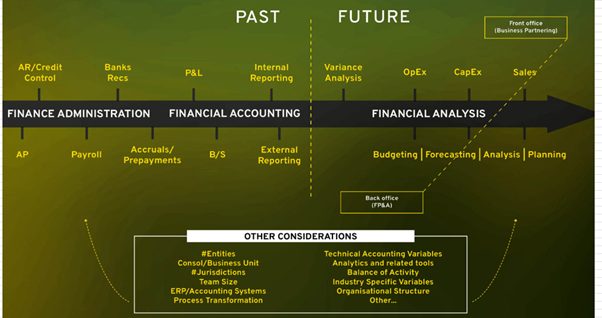
This visual demonstrates that Financial Accounting work is focused on the past, while Financial Analysis roles are looking towards the future.
#3 INTERNAL AUDIT
No confusing alternative job titles here; it’s just known as Internal Audit!
This is the most misunderstood of the categories. Get rid of those ideas of it being the same as External Audit – it’s not!
Internal Audit roles can be a fantastic way of accessing certain industries, which ordinarily may not be accessible to you, given your experience, and to gain an understanding of how a business actually works. Despite initial impressions, IA presents a commercial opportunity, so it’s worthwhile assessing the long-term opportunities that can be afforded to you by choosing an IA role at this stage in your career.
Most of the Group FCs and executive-level finance professional we work with have spent some of their career in IA. Why? Because IA gives you access to senior (if not executive) management like no other role and will enable you to pick your career path within the business in the future, given the exposure you get in the role. If you’re particularly ambitious and are striving for the top, IA is a smart and strategic career move to jump you ahead of your peers, so it’s definitely one you should explore further.
#4 EVERYTHING ELSE
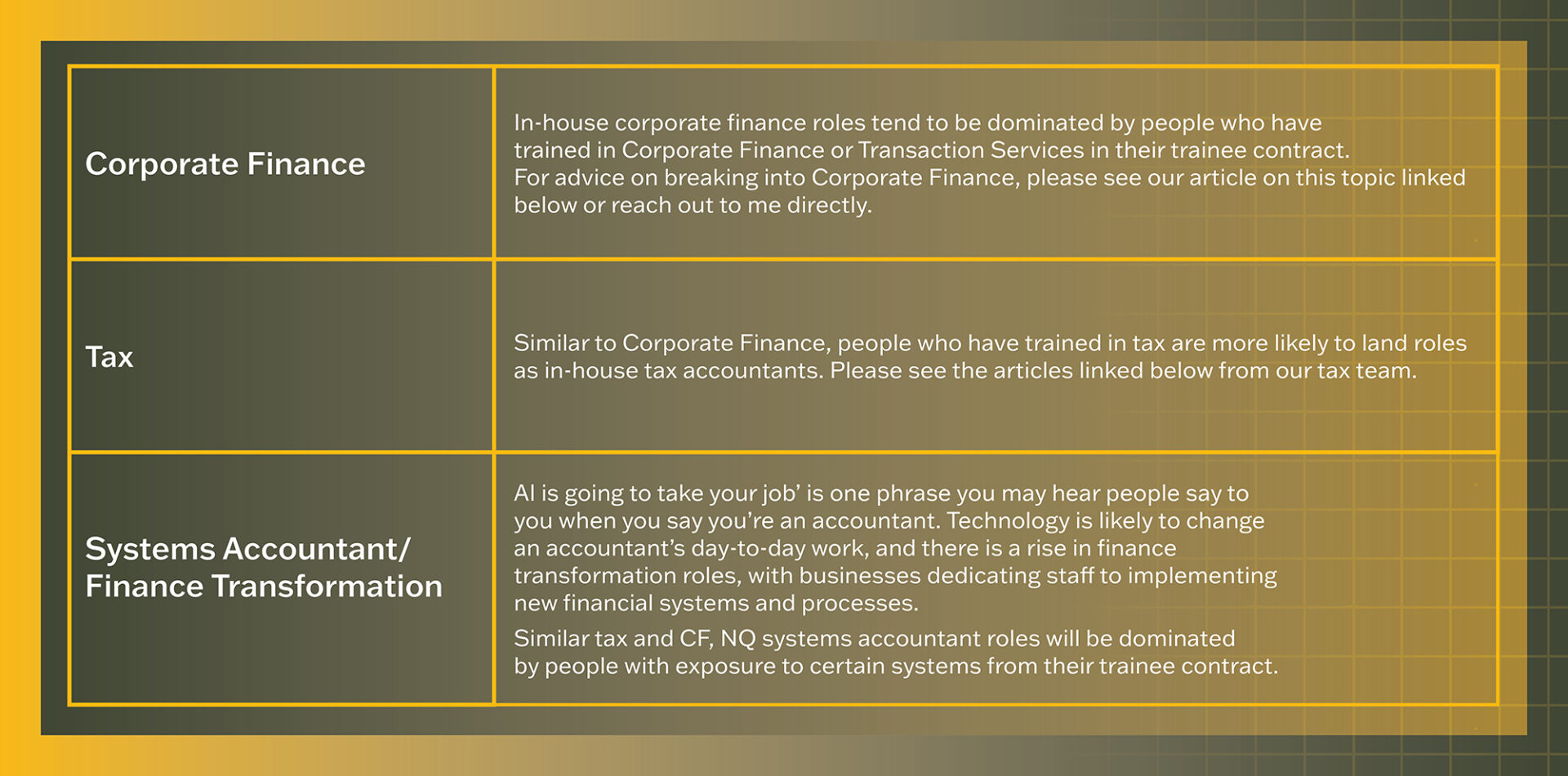
Every other role that falls outside these three areas includes in-house corporate finance, tax accounting, and systems roles. What is worth noting for these roles in industry at NQ level is that the people who land these roles tend to have worked in these areas in practice.
Roles Can be a Blend
Roles within SMEs often blend Financial Accounting and Financial Analysis, reinforcing the point that job titles alone don’t tell the full story. In many cases, a role may involve core financial accounting responsibilities, such as month-end close, accruals and prepayments, and elements of tax compliance (including returns), while also covering more commercial aspects, such as annual budgeting and monthly forecasting. It’s worth keeping this in mind and reviewing the job description carefully to assess where the role sits on that spectrum and what it truly involves day-to-day.
Overall, the key takeaway here is to read beyond the title and get into the details. Do your research on the organisational structure, establish what it is you want from your career and don’t get misled by preconceptions you may have developed in external audit.
Finishing your training contract in 2026? Do you want to make sure you make the very best first step after qualifying? Do you want a coffee meeting with an expert talent advisor; someone who is a qualified accountant, just like you (meet our Leinster team here>>> and our Munster team here>>>)? Do you want a little help to create your very own best financial future? No problem. Just drop us a line today on hello@barden.ie and we will take it from there. Simple.